
Tower Rush RTP is one of the most important topics for players who want to understand the game properly. RTP describes the long-term theoretical return, and it does not predict what will happen in a single session.
Tower Rush is a Galaxsys crash/turbo multiplier game. Many operators show RTP around 96.2%-97.6%, while some provider-side figures may reference up to 97.6%. The exact number sits inside the game information panel of the platform in use.
What Is Tower Rush RTP?
RTP means Return to Player - a long-term mathematical estimate of how much a game returns over a very large number of rounds. If RTP is 97%, the game is theoretically designed to return around ₹97 for every ₹100 wagered over the long run.
It does not mean ₹97 is returned every time, that any single session will return 97%, that the next round is predictable, or that a high RTP removes risk. A full session can be lost even on a high-RTP game.
Tower Rush RTP Range
| Source Type | RTP Range |
|---|---|
| Many operators | 96.2%-97.6% |
| Provider-side references | Up to 97.6% |
| Actual platform | Check game panel |
Why can RTP vary? Operators such as 1win, Odds96 and Parimatch may configure game settings differently. That is why the game information panel matters more than random third-party claims.
Tower Rush Volatility and Risk
Tower Rush volatility depends partly on player behavior.
| Play Style | Cash-Out Target | Volatility |
|---|---|---|
| Conservative | 1.5x-2x | Lower |
| Balanced | 3x-5x | Medium |
| Aggressive | 10x+ | High |
| Bonus chaser | After special floors | Very High |
Cashing out early reduces exposure, while chasing high multipliers increases risk.
Tower Rush Multiplier and Crash Point
Tower Rush starts near x1.00. As floors are built, the multiplier climbs, but the round can collapse before a cash-out is placed. The crash point is the hidden end point of the round. Waiting past it loses the bet. This is why prediction tools do not work: players cannot know the crash point in advance.
Tower Rush Bonus Floors and Game Math
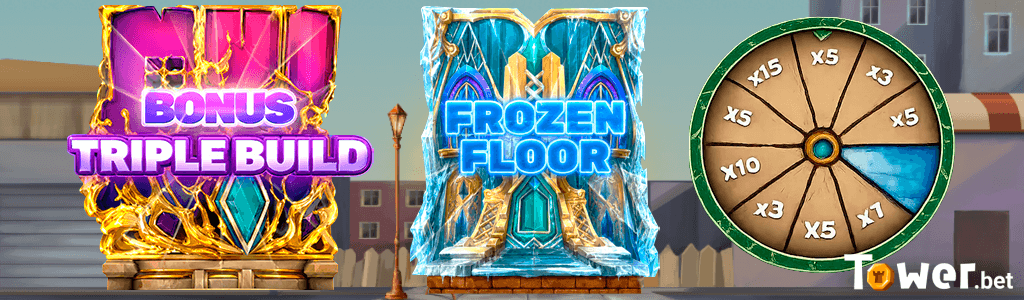
- Frozen Floor may lock or protect part of progress. It reduces pressure, not risk.
- Temple Floor may trigger a multiplier boost or wheel-style feature - more excitement and more risk together.
- Triple Build can add floors faster - bigger movement, but faster exposure.
Bonus floors make the game more interesting, but they do not cancel the house edge.
Tower Rush Provably Fair and RNG
Some Tower Rush platforms may use provably fair or RNG-based systems. A server-side value is created, a client or round value may be added, and the result is generated from these values. Verification may be possible after the round, and outsiders cannot know the next crash point. This is why Tower Rush predictor and hack tools are scams.
Tower Rush Win Rate vs RTP
Win rate and RTP are not the same. Win rate is how often a round ends in a successful cash-out; RTP is long-term value returned. A player cashing out at 1.5x may win more often than one chasing 20x, but the payout is smaller. Neither style guarantees profit.
Tower Rush RTP Across Operators in India
The same Galaxsys title can display a slightly different RTP on different platforms, because an operator selects the configuration it runs. That is why the published band for Tower Rush is usually given as 96.2% to 97.6% rather than a single figure. The lower end and the upper end are both still a Tower Rush experience; the difference is the operator setting, not a different game.
This is also why third-party RTP lists should be treated cautiously. A number copied from a forum, a video or a blog may belong to a different configuration, a different operator or an older build. The reliable source is the game information panel that opens inside the platform itself, since that is the configuration actually paying out. Where the panel and a blog disagree, the panel wins.
Currency and stake settings add a further variable. The minimum bet sits around ₹10 on many India-facing platforms, and the RTP figure is a percentage that holds regardless of stake, but smaller stakes spread across more rounds give the long-run figure more chances to show itself. None of this makes any single session predictable.
Tower Rush and the Long Run Explained
RTP is a statement about a very large number of rounds, not about any one of them. A 97% figure means the game is designed to return roughly ₹97 for every ₹100 wagered once the sample is large enough, with the remainder forming the house edge. A session of fifty rounds is nowhere near that sample size, so short-term results can swing far away from the theoretical number in either direction.
Two players can run the same game on the same day and see very different outcomes, both of which are consistent with the same RTP. That is not a sign of a broken game or a rigged one; it is what variance looks like over a small number of rounds. The practical consequence is that a high RTP is a long-run characteristic that reduces the expected cost of play, not a shield against a losing session.
The honest framing is that Tower Rush returns less than it takes in over time, the published maths makes this transparent, and the only figures that can be relied on are the ones the platform itself documents.
Tower Rush Cash-Out Targets and the House Edge
Cash-out targets change the shape of a session without changing its expected value. A low target such as 1.5x is reached more often but pays less, while a high target such as 10x is reached rarely but pays a larger multiple when it lands. Because the underlying maths already builds in the house edge, no target selection removes it; the choice only changes how often a round ends in a small win against how often it ends in a loss.
| Target | Hit frequency | Session feel |
|---|---|---|
| 1.5x to 2x | Higher | Steadier, smaller wins |
| 3x to 5x | Medium | Balanced swings |
| 10x and above | Lower | Long quiet spells, rare large wins |
Auto-cashout ties a target to the round rather than to reaction speed, which makes a chosen style easier to hold to. Even so, every target still leaves the house edge in place, and a run of rounds can end below the starting balance whatever the setting.
Tower Rush Fairness Checks We Look For
Where a platform says Tower Rush is provably fair, there should be something to verify. A typical implementation commits to a server value before the round, combines it with a value that can be checked afterwards, and produces the crash point from the combination. Verification is done after the round has ended, never before it, which is exactly why no live prediction is possible.
- A round or client value that can be entered on the platform's verification tool.
- A server value that is revealed only once the round has closed.
- A result that matches the published verification for that round.
- RNG-based fairness where a third-party testing lab is named.
- An RTP figure that matches the game information panel.
We treat a provably-fair badge with no verification tool behind it as marketing rather than proof. Real fairness leaves an audit trail; a badge alone does not.
Tower Rush Maths Most Often Misread
There is a short list of ideas that are regularly confused. The first is that RTP is a target for a session, when it is an average across a very large number of rounds. The second is that a long run of losses makes a win due, when each round is independent and the crash point is generated fresh. The third is that a bonus floor raises the RTP, when bonus floors change the flow of a round rather than the edge built into the game.
A fourth confusion is the difference between win rate and return. Cashing out at a low multiplier more often produces more frequent wins, but more frequent wins of a smaller size do not add up to a higher return. Return is governed by the RTP and the targets chosen, not by how often a round ends in a payout.
Clear maths keeps expectations realistic: Tower Rush is designed to entertain, the long-run return is below the amount wagered, and the RTP figure is a documented property of the configuration in use rather than a promise of profit.
Expectation management is the practical takeaway of everything above. Tower Rush can be entertaining and its maths can be transparent at the same time: the game publishes an RTP band, and it does not publish a promise. A session is best planned in advance, with a target and a limit recorded before play begins and a willingness to stop when either is reached. None of that changes the house edge, but it keeps a session inside a budget and turns an unpredictable game into a set of predictable decisions, which is the most a crash game can honestly offer.
Tower Rush RTP & Fairness FAQ
What is Tower Rush RTP?
Many operators show 96.2%-97.6%, while some provider-side references mention up to 97.6%.
Does RTP guarantee winnings?
No. RTP is long-term theory, not a session guarantee.
Is Tower Rush high volatility?
It can be. Volatility increases when players chase high multipliers.
Can bonus floors improve RTP?
Bonus floors affect gameplay, but they do not remove the house edge.
Can Tower Rush be predicted?
No. The crash point cannot be predicted by apps or signals.
What is the safest cash-out style?
Lower targets like 1.5x-2x reduce exposure but still do not guarantee profit.
Does Tower Rush RTP vary between platforms?
Yes. Operators choose a configuration, which is why the published band runs from 96.2% to 97.6%.
Where is the Tower Rush RTP figure shown?
Inside the game information panel on the platform in use, which reflects the live configuration.
Is a loss streak due a win in Tower Rush?
No. Each round is independent and the crash point is generated fresh.
Does a high cash-out target improve RTP?
No. The target changes the shape of a session, not the underlying return.
What is the minimum Tower Rush bet in India?
Many platforms show a minimum of about ₹10, though the exact floor is set by the operator.
We do not guarantee winnings and we do not provide gambling advice. Tower Rush is adult casino entertainment with real financial risk. 18+ only. Support is available 24x7 through the KIRAN helpline: 1800-599-0019.